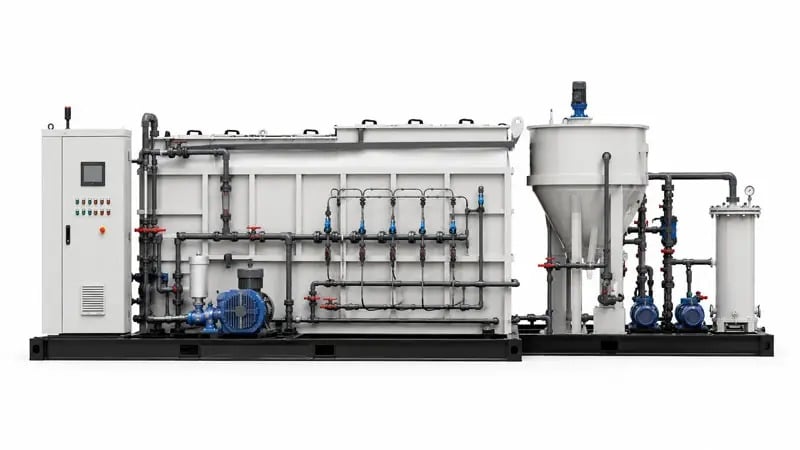
Selecting and deploying an mbbr wastewater treatment plant represents a significant capital investment and operational commitment for industrial and municipal facilities. Before committing to procurement, design teams must answer several foundational questions about system capacity, influent characteristics, and biological performance requirements. The sizing process is not simply a matter of matching flow volume; it demands careful analysis of organic load, carrier fill density, operational flexibility, and long-term treatment objectives. This guide walks through the essential pre-sizing questions that will shape your plant's efficiency, compliance, and cost-effectiveness.

The moving bed biofilm reactor (MBBR) technology offers substantial advantages in compact footprint, biomass retention, and nitrogen removal efficiency compared to conventional activated sludge systems. However, these benefits are only realized when the mbbr wastewater treatment plant is properly sized for your facility's specific hydraulic and organic loading conditions. Undersizing leads to treatment bypass and regulatory violations; oversizing drives unnecessary capital expense and inflated operational costs. Understanding your facility's true flow patterns, pollutant concentrations, and performance targets is the foundation for making sound technical and commercial decisions.
Understanding Your Wastewater Flow Profile
Peak, Average, and Design Flow Rates
The first critical parameter is establishing your facility's flow regime. Most operators think only of average daily flow, but sizing an mbbr wastewater treatment plant requires clarity on peak hourly flow, diurnal variation, and seasonal patterns. Peak flow determines the hydraulic retention time (HRT) and biological kinetics within the reactor; undersizing for peak events will cause washout of biomass and treatment upset. Average flow informs long-term organic loading and energy consumption projections. Many facilities experience significant variation: industrial plants may have concentrated discharge periods, while municipal plants show morning and evening peaks. Collecting 3–6 months of actual flow data before sizing is strongly recommended, as design assumptions often diverge from reality.
Flow Rate Impact on Sizing
Flow rate directly determines the volume of the mbbr reactor and the quantity of carrier fill media required. Higher flow rates at a fixed organic load will reduce the overall treatment efficiency unless the reactor volume and residence time are increased proportionally. The relationship between sizing and flow is not linear; a 20% underestimate in peak flow can compress HRT by 25% or more, significantly reducing treatment capacity. Conversely, oversizing to accommodate rare peak events may waste capital and reduce mixed-liquor biomass concentration. The best approach is to size for average flow with separate surge capacity or equalization upstream, rather than forcing the entire mbbr wastewater treatment plant to accommodate worst-case hydraulics.
Quantifying Organic Load and COD Removal Requirements
COD Concentration and Removal Targets
Chemical oxygen demand (COD) is the primary metric for organic pollutant load and treatment performance in biological reactors. Influent COD concentration—whether 500 mg/L for municipal waste or 2,000 mg/L for food processing—directly impacts the reactor volume, aeration demand, and sludge production rate. When sizing an mbbr wastewater treatment plant, you must establish both influent and effluent COD targets. Regulatory permits typically specify effluent limits (e.g., 100 mg/L COD); working backward from that target and accounting for biodegradable vs. recalcitrant fractions determines the treatment kinetics and reactor volume needed. For high-strength influent, multiple-stage reactors or longer residence times may be required, significantly increasing the mbbr system footprint and cost. Understanding whether your facility can achieve target COD removal in a single-reactor configuration or requires staged treatment is essential before committing to sizing parameters.
Organic Load Distribution and Reactor Volume
The volumetric organic load (kg COD per m³ per day) is a key design metric that correlates directly to reactor volume. A typical mbbr wastewater treatment plant operates at 3–8 kg COD/m³/day for municipal wastewater and up to 15–20 kg COD/m³/day for industrial applications with robust nitrification not required. If your facility produces 100 m³/day of wastewater at 1,000 mg/L COD, the total organic load is 100 kg COD/day. Dividing by your target volumetric load rate yields the required reactor volume. Underestimating COD concentration or overestimating the treatment rate will result in a system that cannot meet effluent standards. Industrial facilities must also account for seasonal or batch variations in influent strength; building in 15–25% design margin for organic load fluctuations is prudent.
Carrier Fill Media and Biofilm Development
Selecting Carrier Fill Density and Material
The carrier fill is the physical substrate on which biofilm develops in an mbbr wastewater treatment plant. Fill density (typically 300–800 m²/m³ of specific surface area, with fill volume occupying 40–70% of total reactor volume) determines the available biofilm growth area and thus the active biomass concentration. Higher fill density supports greater biological kinetics per unit volume, allowing smaller reactors; however, excessive fill density can reduce mixing efficiency, create dead zones, and increase aeration demand. The material choice—whether polyethylene, polypropylene, or specialized composites—affects buoyancy, chemical durability, and biofilm adhesion. Selecting the appropriate carrier fill for your specific COD composition, temperature range, and operational dissolved oxygen setpoint is critical to achieving the projected organic removal capacity and nitrification rates.
Biofilm Dynamics and Sizing Margins
Biofilm thickness and activity on the carrier fill are not static; they respond to influent composition, aeration intensity, and shear forces. When sizing an mbbr wastewater treatment plant, design engineers must account for the fact that biofilm takes 2–4 weeks to establish after startup and reaches stable maturity after 6–12 weeks. During ramp-up, the system will not achieve full design capacity; temporary storage or sequential commissioning of treatment stages is recommended. Additionally, the carrier fill material can degrade or become fouled if operating conditions drift outside design parameters. Specifying robust carrier materials and design safety margins of 20–30% for long-term biofilm stability helps ensure the mbbr system maintains performance over its 15–20 year operational life without requiring replacement of media.
FAQ
What is the typical hydraulic retention time (HRT) for an MBBR system?
Hydraulic retention time in an mbbr wastewater treatment plant typically ranges from 2 to 8 hours, depending on influent COD concentration, treatment objectives, and carrier fill density. Municipal wastewater treatment systems generally operate at 4–6 hours HRT, while industrial systems treating high-strength waste may require 6–10 hours or longer. Shorter HRT reduces reactor volume and capital cost but demands higher fill density and more robust aeration. The HRT must be long enough to allow biofilm organisms adequate time to metabolize organic compounds and oxidize ammonia-nitrogen if nitrification is required. Calculate HRT as reactor volume divided by average flow rate; this parameter must be verified during design to ensure COD removal and effluent quality targets are met.
How does seasonal wastewater temperature affect MBBR sizing?
Temperature profoundly influences biofilm activity and nitrification kinetics in an mbbr wastewater treatment plant. Biological reaction rates approximately double for every 10 °C increase in temperature; consequently, cold-climate facilities or systems treating chilled influent must account for reduced treatment capacity during winter months. When sizing an mbbr system for seasonal climates, designers typically use a winter design temperature (e.g., 10 °C) to ensure year-round compliance with effluent limits. This approach may result in a larger reactor than the average annual temperature would suggest. Conversely, tropical or warm industrial processes may achieve more compact reactor dimensions. Influent temperature data collection over all seasons is highly recommended before finalizing mbbr system sizing to avoid undersizing for worst-case thermal conditions.
What role does aeration intensity play in MBBR sizing?
Aeration intensity directly impacts both COD oxidation and nitrogen removal rates within an mbbr wastewater treatment plant, which in turn influences the minimum reactor volume required to meet treatment targets. Adequate aeration ensures biofilm organisms maintain high metabolic activity and carrier fill media remain suspended and in contact with influent. Insufficient aeration leads to anaerobic zones within biofilm, reduced treatment efficiency, and potential odor generation. However, excessive aeration increases operating energy costs and operating expenses without proportional improvement in treatment; it can also cause carrier media to escape the reactor or fragment. The aeration demand is typically specified in kg O₂/kg COD removed or as volumetric air supply per unit HRT, and must be carefully balanced during sizing to optimize both capital and lifecycle costs of the mbbr system.

 EN