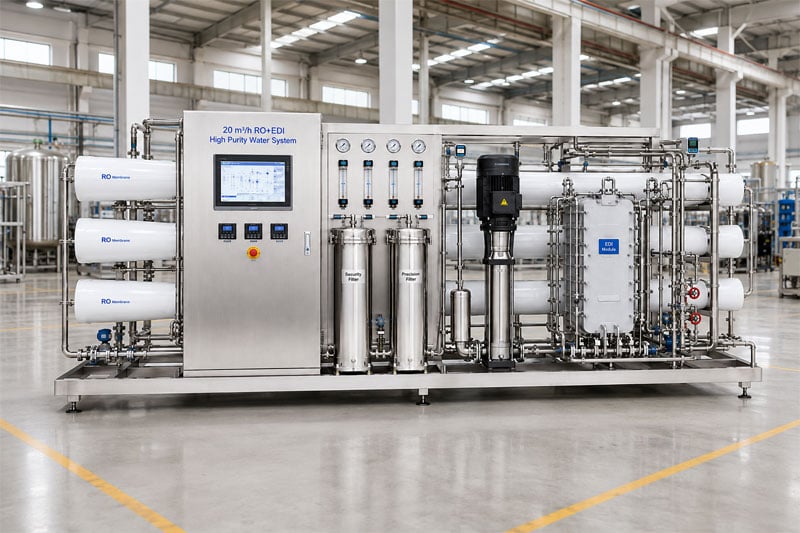
Semiconductor manufacturing demands absolute precision in every aspect of production, and water quality stands as one of the most critical factors determining yield and device performance. The ultra-pure water used in semiconductor fabs must meet extraordinarily stringent specifications, with resistivity levels often exceeding 18 megohms per centimeter and total dissolved solids measured in parts per trillion rather than parts per million. Achieving and maintaining such purity requires a sophisticated, multi-stage approach, which is why ultrapure water for semiconductor manufacturing systems virtually always combine reverse osmosis (RO) and electrodeionization (EDI) technologies working in tandem.
Water purity directly influences contamination control throughout fabrication processes. Particles, ions, and organic compounds present in incoming water can damage photolithography masks, compromise circuit patterns, and trigger device failures during manufacturing. Industrial facilities recognize that a single-technology approach cannot deliver the consistency and purity levels that modern semiconductor production requires, making the combination of RO and EDI not merely an option but an industry standard.
Why RO and EDI Technologies Must Work Together
The Limitations of Reverse Osmosis Alone
Reverse osmosis represents a mechanical separation process that forces feedwater through a semipermeable membrane under pressure, rejecting dissolved salts and most contaminants. While RO effectively removes approximately 95 to 99 percent of dissolved ions, it cannot eliminate all ionic species or achieve the resistivity levels demanded in semiconductor manufacturing. Additionally, RO systems have practical limitations regarding operating efficiency and membrane lifespan when pushed to ultra-pure specifications, and they typically produce 50 to 75 percent permeate with the remainder discharged as brine.
Why EDI Completes the Purification Chain
Electrodeionization operates through an electrical field applied across ion-exchange resin beds, continuously regenerating the resin without chemical additives and removing trace ionic impurities that RO alone cannot address. When RO output feeds into an EDI system, the EDI polishes the water further, achieving resistivity levels above 15 megohms and often exceeding 18 megohms per centimeter. EDI excels where RO performance plateaus, making it the essential finishing stage for semiconductor-grade water production. This synergistic combination addresses both mechanical and ionic purification challenges simultaneously.
Technical Integration of RO and EDI Systems
Multi-Stage System Architecture
Modern semiconductor facilities employ a logical sequence where incoming municipal or well water first undergoes pretreatment to remove sediment, chlorine, and other fouling agents that would damage membranes. The water then passes through RO modules that reduce the dissolved solids load significantly, bringing resistivity into the range of 5 to 10 megohms. The RO permeate then flows into EDI stacks where the electrical field regenerates ion-exchange resins continuously, eliminating dissolved ions down to ultra-trace levels and lifting resistivity to specification. This staged approach optimizes each technology for its specific strengths, ensuring predictable performance and extended equipment lifespan.
System Monitoring and Control Logic
Integration of RO and EDI systems requires continuous monitoring of conductivity, resistivity, and product water flow rates. Real-time feedback loops adjust operating parameters, including feed pressure for the RO stage and electrical current for the EDI stage, maintaining output quality and preventing membrane fouling or resin exhaustion. Advanced systems employ redundancy and automatic switchover capabilities, ensuring uninterrupted ultra-pure water supply to the fabrication line. Many semiconductor manufacturers implement data logging and trend analysis to predict maintenance intervals and optimize system efficiency across multiple production shifts.
Business and Operational Benefits of Combined Systems
Meeting Stringent Purity Requirements Consistently
Semiconductor wafer fabs cannot tolerate variability in water quality, as even minor fluctuations in resistivity or ion concentration risk impacting device yields and reliability. The combined RO and EDI approach delivers stable, repeatable ultra-pure water quality that meets or exceeds 18.2 megohm specifications, reducing the risk of water-related defects and rework. Consistent purity also protects downstream equipment, including deionized water distribution loops, cooling systems, and chemical delivery lines, extending their operational life and reducing maintenance costs.
Economic Efficiency and Long-Term Cost Performance
Although a combined RO and EDI system represents a higher initial capital investment than either technology alone, the operational economics strongly favor the integrated approach for semiconductor manufacturing. RO membranes last significantly longer when not forced to achieve ultra-pure specifications single-handedly, and the EDI stage requires no chemical regeneration, eliminating ongoing costs for acids, bases, and waste disposal. Water recovery rates improve because less feed water is rejected as brine, and energy consumption remains reasonable when components operate within their optimal performance envelope. Facilities report total cost of ownership advantages over time through reduced downtime, membrane replacement frequency, and chemical handling requirements.
FAQ
Why cannot EDI alone produce ultrapure water for semiconductor manufacturing?
EDI systems work most efficiently on water that has already been pre-treated and partially demineralized. When EDI receives raw feedwater with high dissolved solids, the ionic load overwhelms the ion-exchange resin capacity, reducing efficiency and shortening operating cycles between maintenance intervals. RO first reduces the dissolved solids burden to a manageable level, allowing EDI to focus on removing trace ions and achieving the ultra-high resistivity that semiconductor processes demand. The two technologies are complementary rather than redundant.
What specific resistivity levels must ultrapure water achieve in semiconductor manufacturing?
Industry standards typically specify resistivity of 18 megohms per centimeter or higher, with many advanced fabs targeting 18.2 megohms. Total dissolved solids must remain below 5 parts per trillion, and individual ion concentrations for sodium, potassium, chloride, and silica must each stay within single-digit parts per trillion ranges. These extreme specifications reflect the sensitivity of modern semiconductor devices to ionic contamination, which can cause electrical defects or accelerate corrosion of metal interconnects within circuits.
How does a combined RO and EDI system prevent water quality degradation during storage and distribution?
Ultra-pure water is highly corrosive and absorbs contaminants readily from air and pipe surfaces. Combined RO and EDI systems often include polishing loops that continuously circulate ultra-pure water through the system, regenerating resistivity and removing any ions that diffuse into storage tanks or distribution lines. Many facilities employ stainless steel or specially lined piping, deionization cartridges at point-of-use locations, and UV treatment to prevent biological growth and organic contamination. This multi-barrier approach maintains purity from the point of generation through delivery to processing equipment.

 EN






