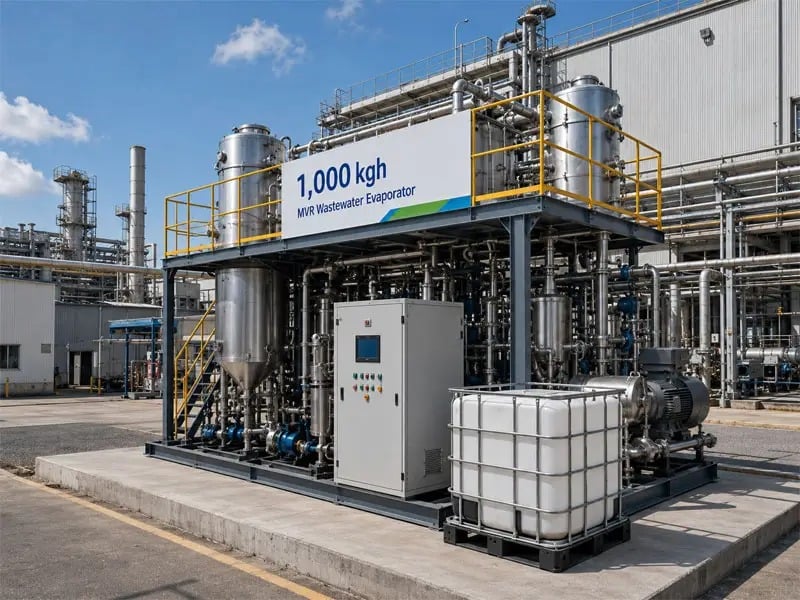
The evaporation of brine is a fundamental process in industrial wastewater treatment, food production, and chemical manufacturing. As salt concentration rises within a brine solution, the physical and chemical properties of the liquid undergo significant transformations that directly affect evaporation rates, energy requirements, and final product quality. Understanding these changes is critical for optimizing industrial operations and improving economic efficiency.
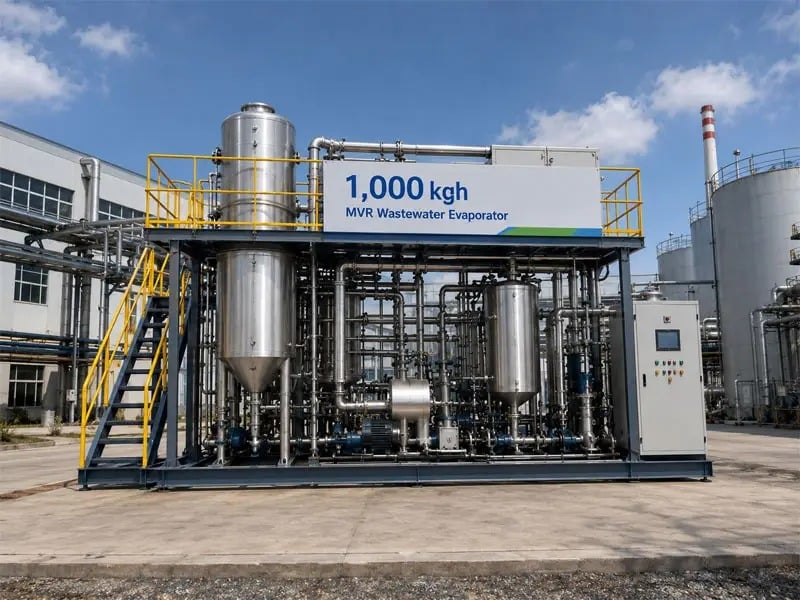
When brine undergoes evaporation, the concentration of dissolved salts increases progressively. This rising salt concentration fundamentally changes the solution's behavior, influencing how water molecules escape as vapor, how much thermal energy is required, and when crystallization begins. The relationship between brine composition and evaporation behavior extends beyond simple physics into practical industrial challenges that demand careful process control and equipment design.
How Salt Concentration Affects Boiling Point
Elevation of Boiling Point Temperature
One of the most important changes that occurs during brine evaporation is the elevation of the boiling point. As salt concentration increases, the boiling point of the solution rises above 100 degrees Celsius. This phenomenon, known as boiling point elevation, occurs because dissolved salt particles interfere with water molecule escape from the liquid phase. Higher salt concentration means more dissolved particles, which means higher boiling temperatures are needed to provide sufficient thermal energy for water molecules to transition to vapor.
The boiling point elevation is not linear with salt concentration. A dilute brine solution with 5% salt concentration might boil at 101 degrees Celsius, but a concentrated solution with 25% salt concentration could boil at 108 degrees Celsius or higher. This nonlinear relationship has profound implications for industrial brine evaporation. As operations progress and brine becomes more concentrated, more steam or heat is required per unit of water evaporated, reducing overall process efficiency and increasing operational costs.
Practical Implications for Evaporation Systems
Industrial facilities managing brine evaporation must account for this boiling point shift when designing heat exchangers and evaporator vessels. Traditional steam-driven evaporators become less efficient as salt concentration rises because the temperature differential between the heating medium and the brine decreases. Multi-effect evaporators are often employed to recover waste heat and maintain economic viability. The choice of evaporation technology directly depends on understanding how salt concentration will progressively change boiling point requirements throughout the process cycle.
Changes in Evaporation Rate and Density
Declining Evaporation Rate
As salt concentration increases within brine solutions, the evaporation rate typically declines. This occurs because dissolved salts reduce the vapor pressure of water molecules at the liquid surface. Water molecules require more energy to escape from a concentrated brine solution than from pure water. The presence of salt ions attracts and holds water molecules more tightly through ionic interactions, effectively lowering the driving force for evaporation. Industrial operators observe this effect as processing time extends when handling increasingly concentrated brine streams.
The relationship between salt concentration and evaporation rate becomes especially critical in multi-stage evaporation operations. Early-stage evaporators processing dilute brine achieve higher throughput compared to later stages handling concentrated brine. This necessitates larger heat transfer areas in downstream evaporators or longer residence times to achieve target water removal. Understanding this concentration-dependent behavior allows engineers to rightsize equipment and predict processing timelines accurately.
Density and Viscosity Increases
Rising salt concentration also increases the density and viscosity of brine solutions. Denser brine occupies less volume and flows less readily through process equipment. Higher viscosity means reduced heat transfer efficiency within exchangers and slower settling of suspended particles. These physical property changes affect pumping requirements, heat recovery efficiency, and overall system hydraulics. Industrial brine management systems must accommodate these density and viscosity shifts through careful equipment selection and operational adjustments.
Formation of Crystals and Salt Precipitation
Crystal Formation During Concentration
As evaporation proceeds and salt concentration rises, the solution eventually approaches saturation, at which point crystals begin to form. Different salts precipitate at different concentration levels and temperatures. Sodium chloride, for example, shows relatively consistent crystallization behavior, but mixed-salt brines display complex precipitation patterns. Crystal formation marks a critical transition point where the brine changes from a single-phase liquid to a mixture of liquid and solid phases. This transition profoundly impacts equipment operation and requires process adjustments to prevent scaling and equipment damage.
The nature of crystals that form depends on brine composition, temperature, and evaporation rate. Slow evaporation often produces larger, more regular crystals, while rapid evaporation can create smaller, more irregular crystal structures. Industrial operations must control crystallization carefully to achieve desired salt product quality and prevent uncontrolled precipitation that could clog equipment. Understanding salt concentration thresholds for crystallization helps operators maintain optimal process conditions and recover valuable salt byproducts.
Equipment Challenges and Solutions
Crystal precipitation poses significant challenges to industrial equipment. Salt deposits accumulate on heat transfer surfaces, forming scale that reduces thermal conductivity and increases maintenance requirements. Specialized crystallizer designs and automated cleaning systems are often integrated into concentrated brine evaporation systems. Operators monitor salt concentration continuously to optimize the timing of crystal removal and maintain stable operating conditions. The economics of brine evaporation increasingly depend on managing crystallization challenges effectively and recovering crystalline salt products of commercial value.
FAQ
Why does boiling point increase when salt concentration rises in brine solutions?
Salt particles dissolve into ions that surround and interact with water molecules, reducing the water's vapor pressure. This ionic interference requires higher temperatures to provide sufficient molecular energy for water molecules to escape as vapor. The higher the salt concentration, the greater this boiling point elevation effect becomes, making the solution thermodynamically more resistant to evaporation.
How does salt concentration affect industrial evaporation efficiency?
As salt concentration increases, the evaporation rate decreases while boiling point rises, both reducing efficiency. Higher energy input is required per unit of water removed, and process time extends significantly. Industrial systems must be designed with larger heat transfer surfaces or multi-effect configurations to maintain economic viability when processing concentrated brine streams with high salt concentration levels.
At what point does crystallization occur during brine evaporation?
Crystallization begins when the brine reaches saturation, which depends on the specific salt composition, temperature, and brine concentration. Different salts saturate at different concentration levels. Sodium chloride typically saturates around 26-27% concentration at standard conditions. Operators must monitor salt concentration carefully to anticipate crystallization and implement appropriate equipment controls before precipitation begins affecting system performance.

 EN