1. Wastewater Sources, Typical Pollutants & Water Characteristics
Brewery wastewater is primarily generated from malt mashing, fermentation and brewing, bottle washing, equipment cleaning, spent grain washing, and plant floor cleaning operations. It is a typical high-strength organic wastewater commonly found in the food and beverage industry.
The wastewater generally consists of high-strength fermentation residues, medium- and low-strength cleaning wastewater, and workshop washdown wastewater. Typical contaminants include starch, sugars, proteins, yeast residues, organic acids, as well as elevated COD, BOD, ammonia nitrogen (NH₃-N), and total phosphorus (TP).
Although brewery wastewater is highly biodegradable and generally contains no heavy metal contamination, it is characterized by significant fluctuations in both flow rate and pollutant concentration due to batch production and bottling operations. Periodic discharges of high-strength wastewater can overload treatment systems, resulting in eutrophication risks, sludge bulking, and odor generation caused by the fermentation and acidification of organic matter. Consequently, brewery wastewater treatment has become a critical environmental management issue for the brewing industry.
2. Common Customer Challenges
Brewery wastewater treatment presents several industry-specific challenges:
- Intermittent brewing operations create substantial fluctuations in wastewater flow and organic loading, causing shock loads to biological treatment systems and increasing the risk of COD and ammonia discharge violations.
- High volumes of biological sludge with unstable settling characteristics often lead to sludge bulking, poor clarification performance, and increased operational complexity.
- Conventional wastewater treatment systems typically have limited resistance to hydraulic and organic shock loads, resulting in unstable effluent quality during peak production periods.
- Standardized treatment equipment often lacks sufficient corrosion resistance and anti-fouling performance to withstand organic acid corrosion and sticky organic contaminants, leading to scaling, biofilm growth, and equipment fouling.
- Many breweries operate within space-constrained facilities while frequently expanding production capacity, making traditional civil wastewater treatment plants difficult to upgrade or expand. As a result, flexible and customized treatment solutions are increasingly required.
3. Treatment Process & Core Equipment Configuration
Based on the characteristics of brewery wastewater, we adopt a proven treatment process consisting of:
Screening → Flow Equalization → Anaerobic Treatment → Aerobic Biological Treatment → Secondary Sedimentation & Advanced Filtration → Water Reuse
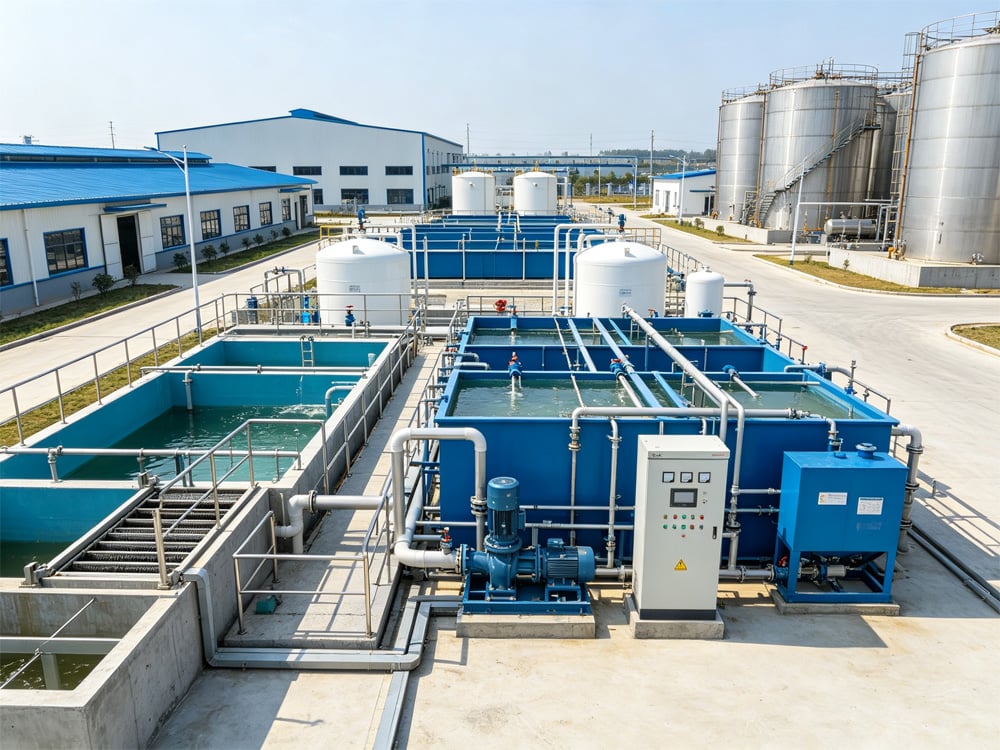
Wastewater first passes through mechanical screens to remove suspended solids, spent grains, and coarse debris. An equalization tank stabilizes flow rate and pollutant concentration before biological treatment.
High-strength organic wastewater is efficiently treated using a UASB (Upflow Anaerobic Sludge Blanket) reactor, significantly reducing COD and converting organic matter into biogas. The anaerobic stage is followed by an A/O (Anoxic/Oxic) biological treatment system, which removes residual organic pollutants, ammonia nitrogen, and total phosphorus.
Finally, secondary clarification and precision filtration ensure stable compliance with discharge standards. The treated water can be reused for plant floor washing, preliminary equipment cleaning, and other non-potable applications, improving overall water utilization.
Core equipment includes:
- Mechanical bar screens
- Flow equalization system
- UASB anaerobic reactor
- A/O biological treatment system
- High-efficiency sedimentation tank
- Intelligent chemical dosing system
- Online water quality monitoring system
- Fully automated PLC electrical control system
4. Solution Advantages
This solution is specifically engineered for the intermittent production characteristics of breweries, providing high organic removal efficiency and excellent resistance to hydraulic and organic shock loads while maintaining stable long-term effluent quality.
Customized non-standard equipment is available based on production capacity, peak discharge flow, and available installation space. Compact modular systems featuring corrosion-resistant construction, anti-clog flow channels, and optimized hydraulic design are tailored for wastewater containing organic acids and highly adhesive organic substances, effectively minimizing biofilm growth, equipment fouling, and pipeline blockage.
All core mechanical, electrical, and water treatment equipment is certified to CE and UL international standards, ensuring reliable operation, safety compliance, and compatibility with international food and beverage industry requirements.
The treatment process provides excellent sludge settling performance, effectively preventing sludge bulking while reducing operating costs through a high level of automation.
Additional benefits include:
- Stable compliance with environmental discharge regulations
- Water reuse rates of up to 90%
- Reduced freshwater consumption and operating expenses
- Compact modular design with a small installation footprint
- Flexible expansion for future production capacity increases
- Fully automated operation with minimal operator intervention
5. Project Experience & Supporting Documentation
We have successfully delivered wastewater treatment systems for numerous large-scale breweries.
A representative reference project is a comprehensive brewery wastewater treatment and water reuse system with a treatment capacity of 1,500 m³/day. The system effectively addresses high-strength organic shock loads, sludge instability, and fluctuating effluent quality while maintaining stable year-round operation. The project successfully passed environmental compliance inspections and continues to support reliable brewery production.
Supporting qualifications include:
- Proprietary patents for brewery wastewater treatment technologies
- CE, UL, and ISO certified equipment
- Third-party water quality testing reports
- Project completion and acceptance documentation
- Proven references within the food and beverage industry
6. Service Scope & Cooperation Process
We provide turnkey EPC (Engineering, Procurement & Construction) solutions for brewery wastewater treatment, covering the entire project lifecycle, including:
- On-site investigation and assessment
- Wastewater sampling and laboratory analysis
- Customized process engineering and system design
- Non-standard equipment manufacturing
- Installation and commissioning
- Operation & maintenance (O&M) services
- System upgrading and capacity expansion
- Lifetime supply of spare parts and consumables
Standard Project Workflow
- Site survey, wastewater sampling, and laboratory water quality analysis
- Development of a customized treatment solution and commercial proposal based on brewery production conditions
- Contract execution followed by equipment manufacturing and on-site construction
- System installation, commissioning, and integrated trial operation until stable compliance is achieved
- Assistance with environmental acceptance inspections and operator training
- Long-term preventive maintenance, system optimization, and 24/7 technical support

 EN