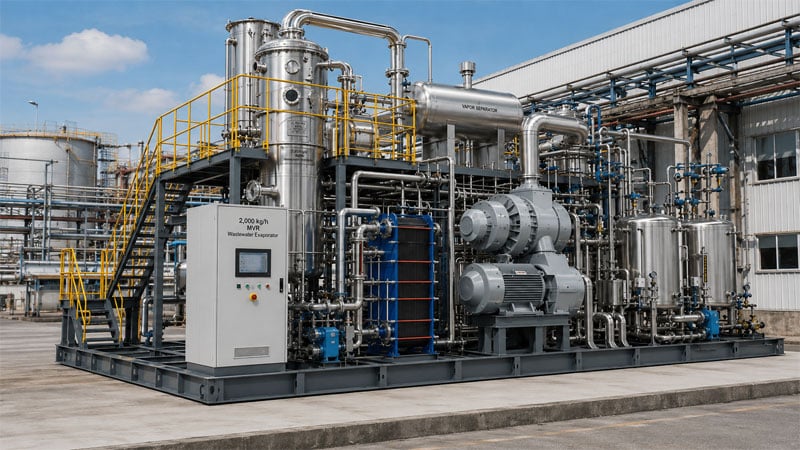
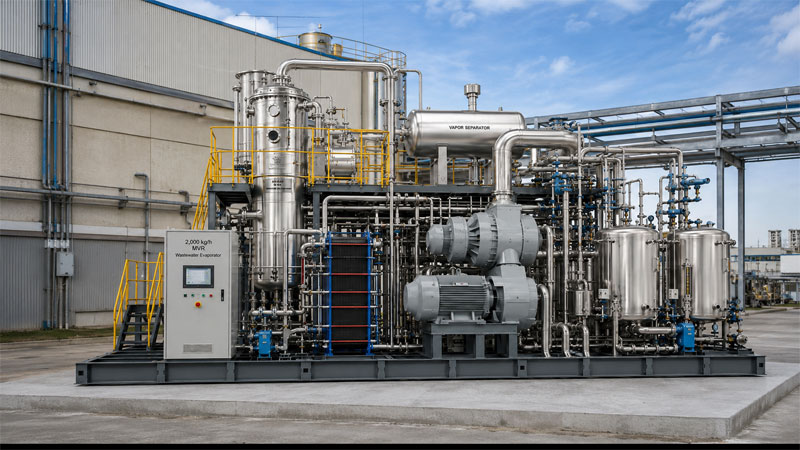
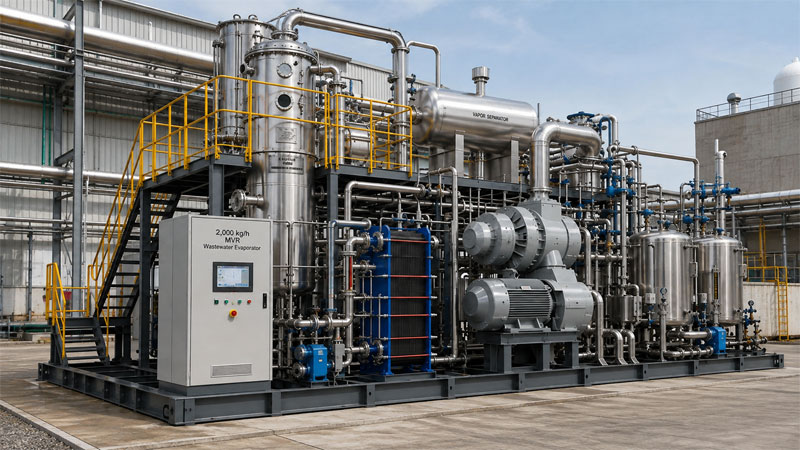
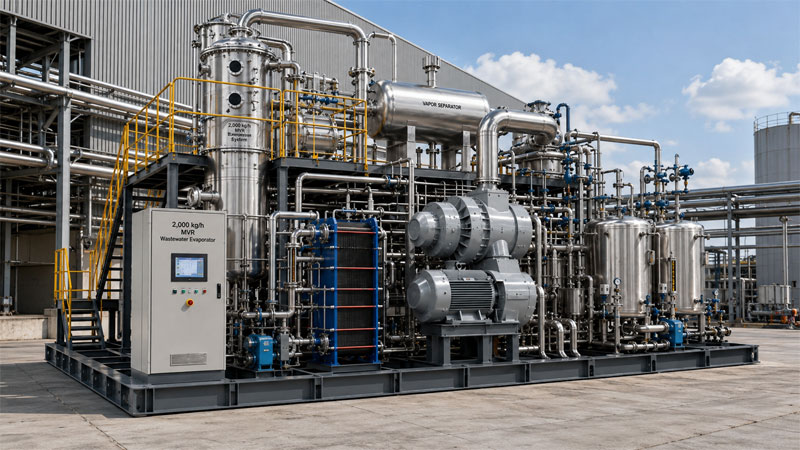
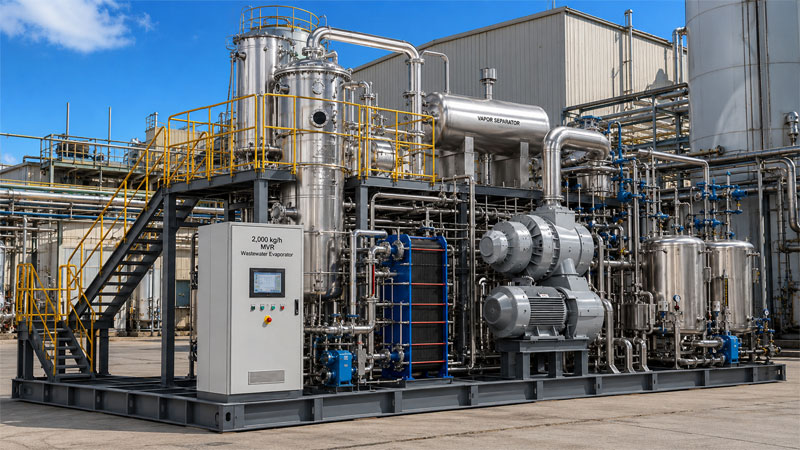
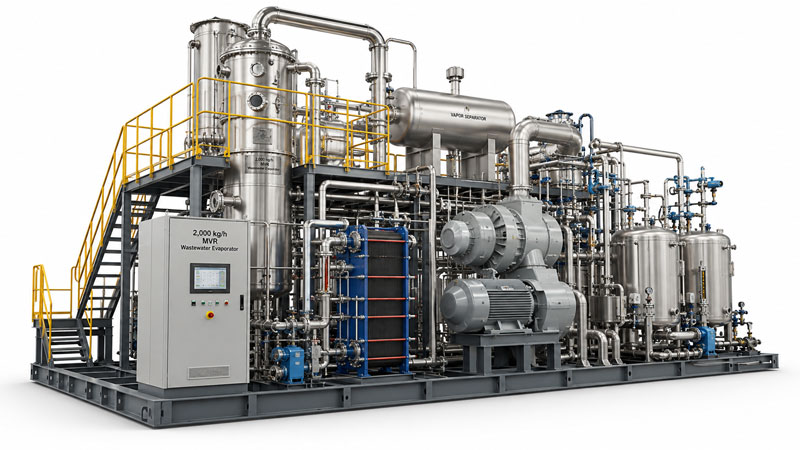
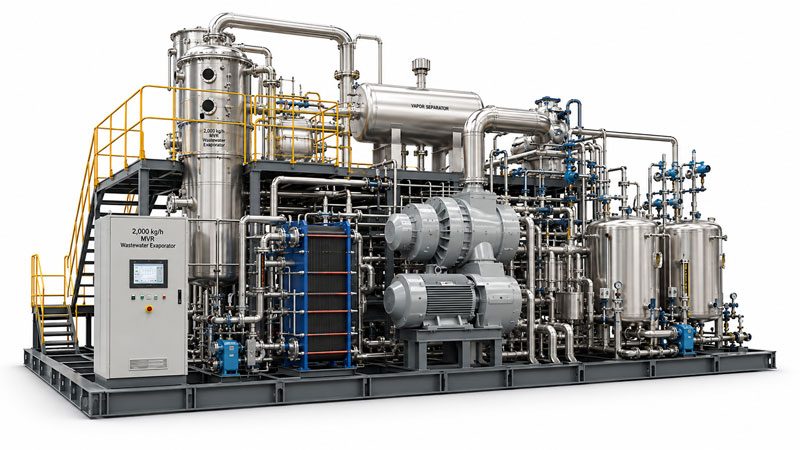
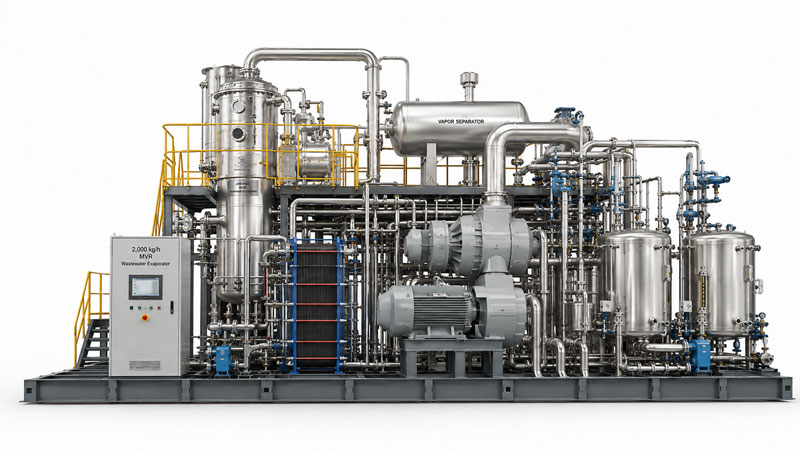
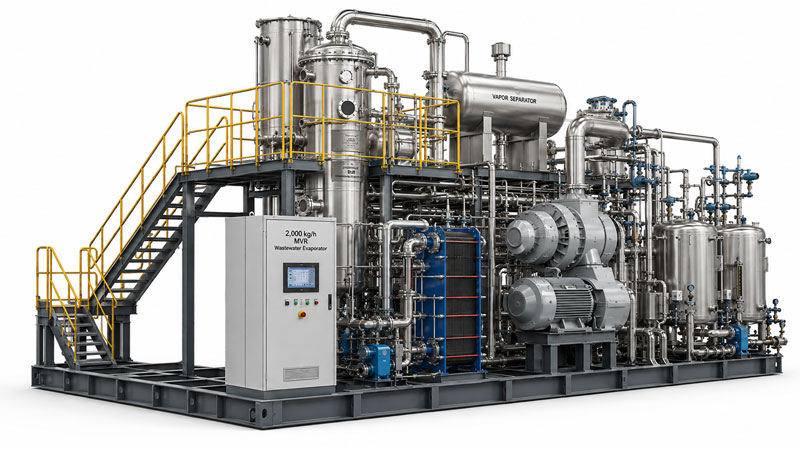
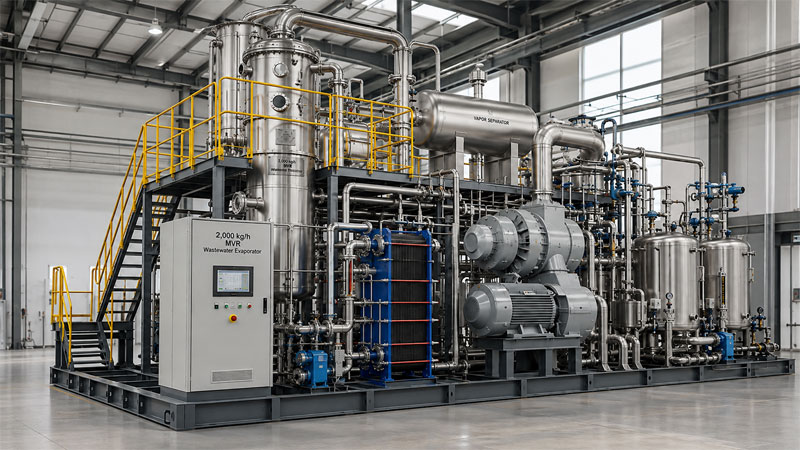
2,000 kg/h MVR Wastewater Evaporator
The 2,000 kg/h MVR Wastewater Evaporator is a high-performance core device designed for large industrial facilities, delivering stable, continuous wastewater concentration and reliable water recovery. Tailored for high-flow, variable-salinity and long-hour operation scenarios, this MVR wastewater evaporator helps industrial projects cut discharge loads, recycle reusable water and lower overall operational costs efficiently.
Serving as the core of a complete wastewater evaporation system instead of a standalone unit, the MVR evaporator is widely applied in lithium battery, new energy, chemical, pharmaceutical and electroplating industries. It supports seamless integration with membrane concentration, heat recovery, crystallization and water reuse processes to meet diverse industrial wastewater treatment demands.
Matched with pre-membrane concentration devices like high-pressure RO, the 2,000 kg/h MVR Wastewater Evaporator effectively reduces thermal load and improves project economy, ideal for treating RO reject, industrial brine and high-salinity wastewater. For ZLD projects, it acts as a key intermediate stage, connecting upstream pretreatment, UF and RO processes with downstream crystallization and solid residue disposal to achieve staged, controllable wastewater treatment.
This MVR wastewater evaporator features flexible material selection including SS316L, duplex steel and titanium, adapting to corrosive wastewater in industrial production. It adopts targeted anti-scaling, defoaming and CIP cleaning strategies to avoid heat transfer surface deposition and foam carryover, ensuring long-term stable operation.
Equipped with standard PLC/HMI control and optional SCADA remote monitoring, the intelligent wastewater evaporation system enables real-time monitoring of density, conductivity and flow, realizing uninterrupted automatic operation. Custom-engineered for actual water quality and reuse targets, this versatile MVR evaporator provides a cost-effective, scalable solution for large-scale industrial wastewater treatment and ZLD system construction.
Key Features
- 2,000 kg/h nominal evaporation capacity
- Heavy-duty continuous industrial design
- Mechanical Vapor Recompression
- High wastewater volume reduction
- Integrated heat recovery
- Automated process control
- Condensate recovery and reuse
- Crystallizer integration available
- Suitable for large ZLD systems
- Modular upstream/downstream integration
Typical Applications
- Large lithium battery plants
- Battery-material factories
- New-energy industrial facilities
- Chemical manufacturing
- Pharmaceutical production
- Electroplating industrial parks
- Electronics manufacturing
- High-salinity membrane concentrate
- RO reject concentration
- Industrial brine
- Zero Liquid Discharge projects
Reference Technical Parameters
| Parameter |
Reference Specification |
| Evaporation Capacity |
2,000 kg/h |
| Technology |
MVR |
| Operating Mode |
Continuous |
| Wastewater Feed |
Project‑specific |
| Feed TDS |
Project‑specific |
| Final Concentration |
Project‑specific |
| MVR Compressor |
Project‑engineered |
| Evaporation Type |
Forced circulation / falling film / combined |
| Operating Pressure |
Vacuum / process‑specific |
| Main Material |
SS316L / duplex / titanium / special alloy |
| Heat Recovery |
Integrated |
| Condensate Recovery |
Available |
| PLC/HMI |
Standard |
| SCADA |
Optional |
| CIP |
Recommended |
| Crystallizer |
Optional |
| Remote Monitoring |
Optional |
Integrated Treatment Concept
The 2,000 kg/h MVR Wastewater Evaporator is a high-performance core unit for large industrial facilities, enabling stable concentration and water recovery. Designed for high-flow, variable-salinity, and long-hour operation, it reduces discharge, recycles water, and lowers costs. Widely used in lithium battery, chemical, pharmaceutical, and electroplating industries, it integrates with membrane concentration, crystallization, and heat recovery. Compatible with pre-treatment like high-pressure RO, it suits RO reject, brine, and high-salinity streams, and serves as a key stage in ZLD systems. Material options include SS316L, duplex steel, and titanium. Anti-scaling, defoaming, and CIP strategies ensure durability. PLC/HMI control with optional SCADA enables real-time monitoring and automation. Custom-engineered for specific water quality and reuse goals, it offers a scalable, cost-effective solution for industrial wastewater treatment.
How It Works
Step 1 — Upstream Concentration
Where technically and economically suitable, membranes can remove water before evaporation, reducing the thermal evaporation load on the MVR evaporator.
Step 2 — MVR Evaporation
The concentrated feed enters the MVR wastewater evaporator, where water is vaporized inside the wastewater evaporation system.
Step 3 — Vapor Recompression
The secondary vapor is compressed to raise its usable thermal energy inside the MVR evaporator.
Step 4 — Internal Heat Recovery
Compressed vapor transfers heat back to the evaporation section, reducing the need for continuous external steam in industrial wastewater treatment.
Step 5 — Condensate Recovery
Condensed vapor is collected and can be polished for reuse as part of the wastewater evaporation system.
Step 6 — Brine Concentration
The remaining wastewater reaches a higher salt and contaminant concentration inside the MVR wastewater evaporator.
Step 7 — Optional Crystallization
For ZLD applications, concentrated brine can enter a crystallizer to separate solids from remaining water after the MVR evaporator.
ZLD Integration
A complete Zero Liquid Discharge solution may include three major stages. In Stage 1, pretreatment removes suspended solids, hardness, silica, oil, heavy metals, organic contaminants, and scaling precursors so the wastewater evaporation system can operate more stably. In Stage 2, RO, high-pressure RO, or other membrane technologies recover water before thermal treatment when feasible. In Stage 3, the MVR wastewater evaporator removes additional water from the membrane concentrate, and a crystallizer can then produce solid salts or concentrated solids for further handling. This staged approach is common in industrial wastewater treatment because it improves energy use and simplifies concentrate management.
Key Design Factors for Large MVR Projects
Scaling
Calcium, magnesium, silica, sulfate, and other salts can create heat-transfer surface deposits in an MVR evaporator.
Corrosion
Chloride, low or high pH, and specific chemical components may require duplex, titanium, or special alloy construction in the wastewater evaporation system.
Boiling-Point Elevation
Concentrated brines can boil at temperatures significantly different from clean water under the same pressure, affecting MVR compressor and heat-transfer design.
Foaming
Organic matter and surfactants can create foam and carryover, requiring separators and antifoaming strategies in industrial wastewater treatment.
Volatile Organics
Some organic contaminants may enter the vapor and condensate, so pretreatment or condensate polishing may be required in the wastewater evaporation system.
Customization Options
- Forced-circulation MVR
- Falling-film MVR
- Multi-effect + MVR hybrid systems
- Membrane concentration pretreatment
- High-pressure RO integration
- Softening pretreatment
- Chemical precipitation
- Heavy-metal removal
- Organic pretreatment
- SS316L
- 2205 duplex
- 2507 super duplex
- Titanium
- Nickel-based alloy options
- Crystallizer
- Salt separator
- Centrifuge
- Filter press
- Mother-liquor recirculation
- Condensate polishing
- RO condensate recovery
- Automated CIP
- Online density monitoring
- Conductivity monitoring
- Flow monitoring
- PLC/HMI
- SCADA
- Remote data monitoring
Why Choose This Model?
At 2,000 kg/h evaporation capacity, customers are usually no longer purchasing only an evaporator. They are evaluating a complete wastewater-reduction or ZLD project, and that means the MVR wastewater evaporator must be judged together with pretreatment, membrane concentration, concentrate handling, and reuse water routing. The main engineering objective is to balance capital cost, energy consumption, water recovery, scaling control, material selection, system availability, maintenance requirements, salt disposal, and long-term operating cost. For this reason, pilot testing or detailed wastewater characterization may be recommended for complex industrial wastewater treatment projects before the wastewater evaporation system is finalized.
FAQ
Is 2,000 kg/h suitable for a ZLD project?
Yes. This capacity can serve as the evaporation stage in a larger ZLD system when properly integrated with pretreatment, membrane concentration, and crystallization in a wastewater evaporation system.
Should membrane concentration be installed before MVR?
Often yes, when wastewater characteristics allow. Membranes generally remove water using less energy than thermal evaporation, so maximizing membrane recovery before the MVR evaporator can improve overall economics.
Can the system produce dry salt?
An evaporator alone normally produces concentrated brine. A crystallizer and solid-liquid separation equipment are usually required to produce solid salt after industrial wastewater treatment.
Can recovered condensate return to production?
Potentially yes. Condensate may require polishing depending on conductivity, COD, ammonia, volatile organics, and the factory's reuse-water specification in the wastewater evaporation system.
How is equipment material selected?
Material selection depends on chloride, temperature, pH, oxidants, organic chemicals, and expected concentration conditions in the MVR wastewater evaporator.
What causes scaling inside an MVR system?
Common causes include calcium carbonate, calcium sulfate, silica, and other salts becoming supersaturated as water evaporates in industrial wastewater treatment.
How is scaling controlled?
Methods can include pretreatment, softening, chemical dosing, pH adjustment, forced circulation, optimized concentration limits, and periodic CIP cleaning in the wastewater evaporation system.
Does an MVR system need operators?
The plant can be highly automated, but routine inspections, water-quality monitoring, chemical management, and maintenance are still required for reliable MVR evaporator operation.
What wastewater data do you need for system design?
A complete wastewater analysis is preferred, including flow, TDS, COD, chloride, sulfate, calcium, magnesium, silica, ammonia, heavy metals, oil, suspended solids, pH, and organic components.
Recommended CTA
Planning an industrial ZLD or large wastewater concentration project? Send us your wastewater analysis, daily wastewater volume, current treatment process, target water recovery, and concentrate-disposal requirements. Our engineering team can evaluate the complete pretreatment, membrane concentration, MVR, and crystallization process for your wastewater evaporation system.
CTA Button: Get ZLD System Evaluation

 EN